
From FAA & Bank Outages to 90-Day Blackouts: How to Prep in NYC
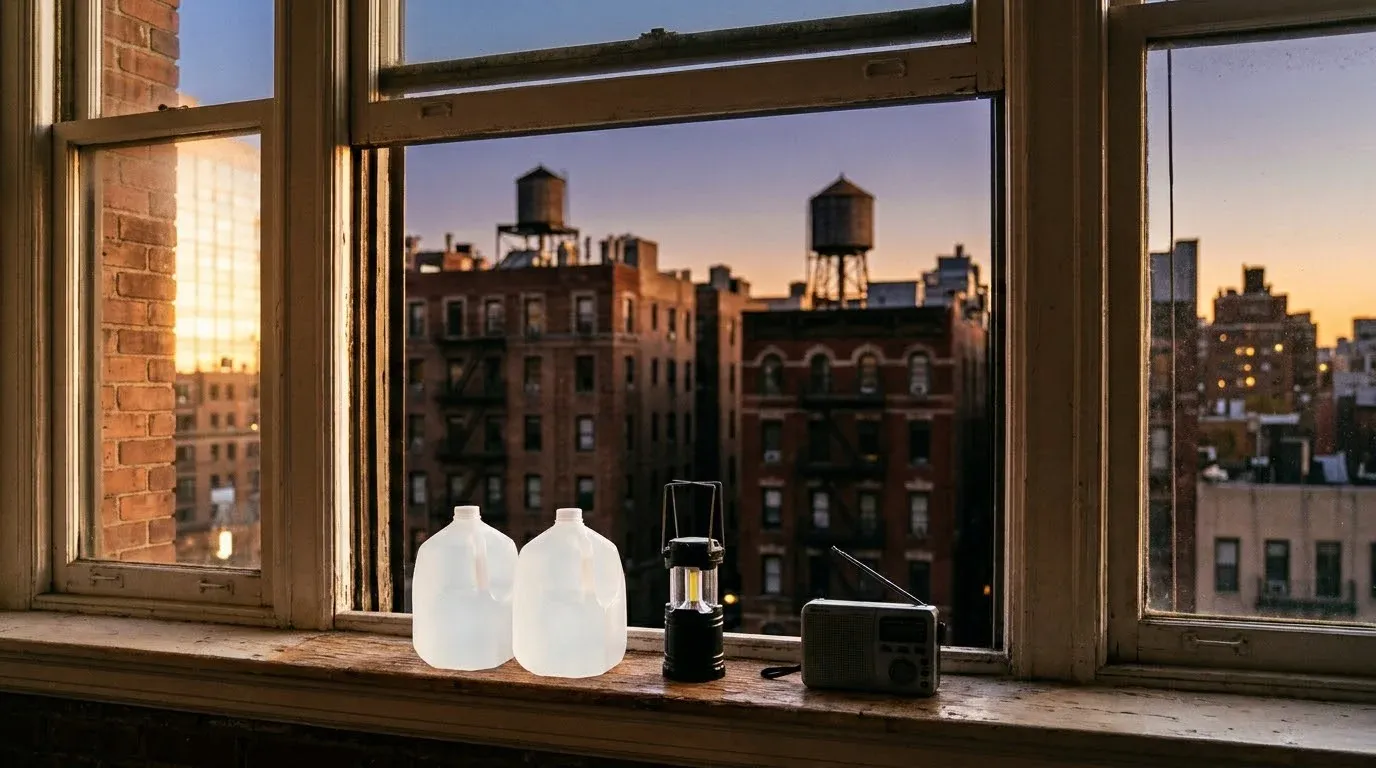
The Pentagon Plans for 90 Days Off-Grid. What Should a NYC Family of Four Do?
On September 30, 2026, Secretary of War Pete Hegseth unveiled FORTRESS America—widely dubbed "Operation Fortress" online—ordering U.S. military bases to prepare for 90 days without civilian power or supply chains. Here is what that directive means, and how a family of four in a New York City apartment or house can build realistic resilience without panic buying.
First, a necessary reality check: there is no federal warning of an imminent 90-day civilian blackout. According to the U.S. Department of War and a Snopes fact-check, FORTRESS America (Federal Operations for Resilience, Troop Resources, Energy, Supply, and Survivability) is a military installation directive, not a household rationing order. Announced at Marine Corps Base Quantico on September 30, 2026, the program aims to end military reliance on vulnerable civilian power grids and foreign supply lines across five pillars: energy independence, domestic supply-chain resilience, strategic reserves of fuel, munitions, and medicine, cyber hardening, and space/spectrum security.
Reporting from The Guardian and California Globe notes that internal planning targets roughly 500 major continental U.S. bases to operate independently for 90 days using microgrids, battery storage, and portable nuclear microreactors. Meanwhile, civilian agencies—from NYC Emergency Management to the UK's Be Ready campaign—still center household guidance on 3-to-14-day windows. For a New York City family of four, whether living in a high-rise apartment or a single-family house in Brooklyn, Queens, the Bronx, or Staten Island, the real lesson is how quickly urban "just-in-time" systems stall when power, water pressure, and delivery trucks stop.
Water Fails Above the Fourth Floor Before It Fails at the Tap
New York City's water supply is gravity-fed from upstate reservoirs, which helps during brief outages—but housing type dictates how long taps keep running. As building engineering guides from Antler Pumps and Pro Pump Corp explain, street-level pressure typically reaches only the fourth to sixth floor. Taller apartment buildings depend on electric booster pumps or rooftop wooden water tanks; once Con Edison power drops and building generators run dry, upper-floor faucets stop even if street mains stay pressurized.
Single-family houses and low-rise townhouses keep gravity pressure longer, and basements or garages can hold 55-gallon food-grade drums or a 56-gallon FEMA reserve (~467 lbs) that would overwhelm an apartment closet. Yet even in a house, storing 360 gallons (3,002 lbs) for a 90-day family-of-four supply is impractical. Both apartments and houses should pair 7 to 14 days of sealed drinking water (28 to 56 gallons for four) with a hollow-fiber membrane filter and unscented household chlorine bleach for emergency disinfection, while monitoring NYC Health radio updates for boil-water advisories.
Power, Winter Heat, and the Carbon Monoxide Trap
In a November or winter outage, both apartments and houses lose central steam, hot-water radiators, or forced-air heat as soon as boilers and circulation pumps lose electricity. Both the CDC and NYC Health warn never to run portable gas generators, charcoal grills, or camping stoves indoors, in basements, or in garages—even with doors open—and never within 20 feet of any window, door, or vent.
In an apartment, rely on pre-charged LiFePO4 portable power stations, foldable solar panels angled out a south-facing window, battery-backed carbon monoxide alarms, and zero-degree sleeping bags in one closed-off interior room. In a house with a yard, a portable inverter generator can run a refrigerator, sump pump, or furnace blower intermittently if placed outdoors more than 20 feet from the structure, alongside winter pipe protection. Families with electric medical devices should register with Con Edison Special Services or National Grid Special Protections.
| Equipment | Apartment | House with Yard | Best Role & Critical Constraint |
|---|---|---|---|
| LiFePO4 Power Station | High | High | 4 phones, NOAA radio, medical gear, LED lights; cannot run electric space heaters |
| Foldable Solar Panel | Moderate | High | Recharging batteries on a sunny sill (apt) or yard/roof (house); winter cloud cover cuts output |
| Gas Generator / Camp Stove | Unsafe | Yard Only | Must sit outdoors >20 ft from all windows/vents; lethal CO risk indoors or in garages |
Minimal vs. Recommended Baselines for Human Survival
Planning for 90 days requires separating bare physiological survival from the nutrition and hygiene needed to stay healthy under stress. FEMA notes that a normally active adult needs at least two quarts (0.5 gallons) of drinking water daily just to avoid dehydration, while Ready.gov and the CDC double that to one full gallon per person per day to cover cooking and basic hygiene. The WHO sets the minimal emergency ration at 2,100 kcal per person per day (+20% if indoor temperatures drop below 68 °F).
| Survival Pillar | Minimal Baseline (Per Person / Day) | Recommended Baseline (Per Person / Day) | Family of 4 (90-Day Scale) |
|---|---|---|---|
| Drinking & Hygiene Water | 0.5 gal (2 qt) drinking only (FEMA) | 1.0 gal (4 qt): drinking + prep & washing (Ready.gov) | 180 gal min · 360 gal rec |
| Daily Calories | 2,100 kcal; +20% if <68 °F (WHO) | 2,000–2,500+ kcal (USDA) | 756,000 kcal min · ~810k+ kcal rec |
| Protein & Fats | 10–15% protein & 17–18% fat (IOM/NCBI) | 1.2–1.6 g/kg protein & 35–45% fat in compact rations (DGA) | Canned fish/beans, nut butters, oil |
| Micronutrients & Electrolytes | Iodized salt + oral rehydration salts | Daily multivitamin, vitamin C/D, canned produce, electrolytes | 360+ doses + 1–2 lbs iodized salt |
| Sanitation & Medical | Contractor bags, sanitizer, 7-day Rx buffer | 2 sealed 5-gal buckets, cat litter, bleach, 30–90 day Rx buffer | 2 buckets, 100+ bags, Rx kit |
Pantry Math and Sanitation for Four Without Running Water
In an apartment, closet space favors no-cook or low-water staples your family already eats: canned beans, sardines or tuna, nut butters, rolled oats, olive oil, and shelf-stable UHT milk, rotated every six months. In a house, basement shelving lets you add bulk dry grains alongside a safe outdoor camp stove for boiling. Eat refrigerated perishables first (a closed fridge stays below 40 °F for 4 to 6 hours; a full freezer holds for 2 days, per NYC Health). If sewers back up, never flush: line a 5-gallon bucket with heavy-duty contractor bags, add cat litter or sawdust, and seal tightly.
Communications, Cash, and Building a Block Network
Family Comms Plan
Enroll in Notify NYC, keep a hand-crank AM/FM and NOAA weather radio, and pick two family meeting spots. Text messages often get through when voice calls fail.
Cash and Prescriptions
Keep small bills ($1s, $5s, $20s) for corner bodegas, waterproof copies of IDs and leases/deeds, and ask your pharmacist about a legal buffer of daily medications.
Neighbors and Mental Health
Know your building superintendent or block neighbors. During prolonged outages, NYC residents can reach free, confidential 24/7 support by calling or texting 988.
"People can think about [Fortress] and think, if our military is doing that, shouldn't I be thinking about that too?" — Lynn Budd, former president of the National Emergency Management Association, speaking to The Guardian
A Phased 90-Day Readiness Roadmap for a Family of Four
| Phase | Horizon | Family of 4 Baseline | Apartment vs. House Adaptation |
|---|---|---|---|
| 1 · Mobile Baseline | 72 Hours | 4 Go Bags, 12 gal water, no-cook bars, cash, ID copies, flashlights, power banks | Apartments: keep by front door, avoid elevators. Houses: keep trunk winter kit and shut-off wrench ready |
| 2 · Shelter-in-Place | 14 Days | 56 gal water (or 28 gal + filter), 2 weeks rotating meals, LiFePO4 battery, CO alarms | Apartments: plan for upper-floor pump loss. Houses: store 56 gal in basement; prep sump backup |
| 3 · Urban Resilience | 30–90 Days | Rotating dry staples, 2 sanitation buckets + liners, Rx/vitamin buffer, solar, block contacts | Apartments: water purification and floor mutual aid. Houses: 55-gal drums, outdoor-only (>20 ft) generator, pipe winterization |